
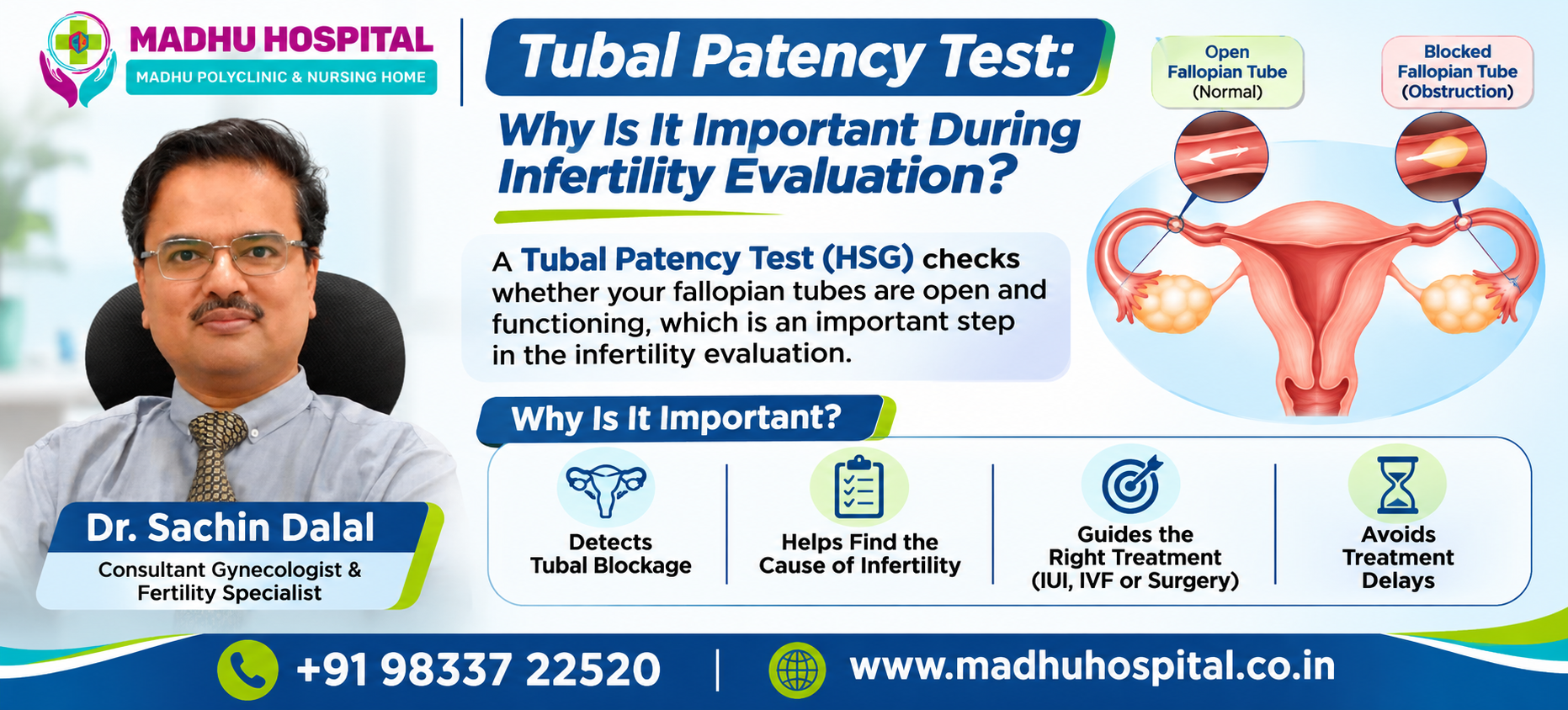
Tubal Patency Test: Why Is It Important During Infertility Evaluation? – Dr. Sachin Dalal (Madhu Hospital)
For many couples, planning a pregnancy is an exciting journey. However, when conception does not happen as expected, it can raise concerns about reproductive health. Infertility can result from several factors, including ovulation problems, hormonal imbalances, sperm-related issues, uterine abnormalities, and blocked fallopian tubes. One important investigation during female infertility evaluation is the Tubal Patency Test in Mumbai, which helps determine whether the fallopian tubes are open or blocked. Healthy fallopian tubes play an essential role in natural conception, and any blockage may make pregnancy more difficult. At Madhu Hospital in Bhandup West, Mumbai, Dr. Sachin Dalal provides gynecological and fertility-related consultation to help patients understand possible causes of infertility and appropriate diagnostic investigations. Understanding the importance of tubal patency testing, how the procedure is performed, and what the results indicate can help couples make informed decisions about their fertility treatment options.
1. What Is a Tubal Patency Test?
A Tubal Patency Test is a diagnostic investigation used to determine whether a woman’s fallopian tubes are open or blocked. The fallopian tubes are two narrow structures connecting the region near the ovaries to the uterus. During natural conception, an egg released from the ovary is picked up by a fallopian tube, where fertilization typically occurs if sperm are present. The fertilized egg then travels toward the uterus for implantation. If one or both fallopian tubes are blocked or damaged, this process may be disrupted, making conception more difficult.
A tubal patency test helps doctors assess whether fluid or contrast material can pass through the fallopian tubes. Common methods include Hysterosalpingography (HSG), an X-ray-based examination, and Hysterosalpingo-Contrast Sonography (HyCoSy), which uses ultrasound imaging. These investigations help identify possible tubal obstruction and guide further fertility evaluation. A normal test suggests that the tubes are open, but it does not guarantee pregnancy or confirm that every aspect of tubal function is normal. The American Society for Reproductive Medicine recommends HSG or ultrasound-based contrast testing as appropriate methods for evaluating fallopian tube patency.
2. Why Are Fallopian Tubes Important for Pregnancy?
Fallopian tubes play a vital role in the natural reproductive process. They help transport the egg and provide the usual location where fertilization occurs.
After ovulation, the egg enters the fallopian tube. Sperm travel through the cervix and uterus toward the tube, where fertilization may take place.
The resulting embryo then travels toward the uterus, where implantation may occur.
When a fallopian tube is blocked, sperm may be unable to reach the egg, or the embryo may have difficulty reaching the uterus.
A woman may still conceive naturally if one fallopian tube is open and other fertility factors are favorable. However, blockage of both tubes can prevent the egg and sperm from meeting naturally.
Tubal damage may also increase the risk of an ectopic pregnancy, in which a pregnancy implants outside the uterus, most commonly in a fallopian tube.
Therefore, assessing fallopian tube health is an important part of investigating certain fertility problems.
3. Why Is a Tubal Patency Test Important During Infertility Evaluation?
A tubal patency test helps doctors understand whether a structural problem involving the fallopian tubes may be contributing to difficulty conceiving.
Identifies Possible Fallopian Tube Blockage
One of the primary purposes of tubal patency testing is to identify whether one or both fallopian tubes may be blocked.
A blockage can interfere with the movement of sperm, eggs, or embryos and reduce the possibility of natural conception.
Helps Investigate Unexplained Infertility
Some couples experience difficulty conceiving even when menstrual cycles appear regular and initial investigations do not identify an obvious problem.
Tubal patency testing may reveal a possible structural factor that requires further evaluation.
Supports Fertility Treatment Planning
The results can help a fertility specialist decide whether additional testing, continued attempts at natural conception, intrauterine insemination (IUI), surgery, or in vitro fertilization (IVF) may be appropriate.
The recommended approach depends on the complete fertility assessment, not the tubal test alone.
Helps Avoid Inappropriate Treatment Delays
When tubal obstruction is suspected, identifying it early may help patients avoid pursuing treatment options that depend on open fallopian tubes.
For example, IUI generally requires at least one functional fallopian tube.
Provides Information About Uterine Anatomy
An HSG test can also provide information about the shape of the uterine cavity and may identify certain abnormalities requiring further investigation.
However, additional ultrasound or hysteroscopic examination may be needed to confirm specific uterine conditions.
Tubal disease is recognized as an important cause of infertility, and the 2026 ASRM guidance emphasizes assessment of tubal patency as part of an appropriate infertility evaluation
4. Who Should Consider a Tubal Patency Test?
A Tubal Patency Test in Mumbai is generally recommended for women who are experiencing difficulty conceiving or have medical conditions that may affect the health and function of their fallopian tubes. Women under the age of 35 who have been trying to conceive for 12 months without success, or women aged 35 and above who have been trying for six months, may benefit from a comprehensive infertility evaluation that includes tubal patency testing when appropriate. This test may also be advised for women with a history of pelvic inflammatory disease (PID), sexually transmitted infections, ectopic pregnancy, endometriosis, pelvic surgery, or suspected fallopian tube blockage. Additionally, women experiencing unexplained infertility despite regular menstrual cycles and normal initial fertility investigations may be advised to undergo an HSG Test or Fallopian Tube Blockage Test to assess whether the tubes are open. Tubal patency testing may also be considered before certain fertility treatments, such as intrauterine insemination (IUI), because at least one functional fallopian tube is generally necessary for the treatment to be effective. At Dr. Sachin Dalal’s Madhu Hospital in Bhandup West, Mumbai, patients can seek guidance regarding infertility evaluation and the need for appropriate diagnostic investigations based on their medical history, age, reproductive health, and fertility concerns. Early diagnosis of tubal abnormalities can help doctors recommend suitable treatment options and avoid unnecessary delays in fertility management.
5. Different Types of Tubal Patency Tests
Several diagnostic methods are available to assess whether the fallopian tubes are open. The choice depends on the patient’s medical history, clinical findings, and available facilities.
Hysterosalpingography (HSG Test)
Hysterosalpingography, commonly known as the HSG test, is an X-ray examination used to assess the uterine cavity and fallopian tubes.
During the procedure, a contrast liquid is introduced through the cervix into the uterus. X-ray images are taken to observe whether the contrast passes through the fallopian tubes and spills into the pelvic cavity.
If the contrast passes through the tubes, they are considered open. If the contrast does not pass normally, a possible blockage may be suspected.
HSG is commonly used as an initial test for fallopian tube patency.
Hysterosalpingo-Contrast Sonography (HyCoSy)
HyCoSy is an ultrasound-based examination that uses a special contrast medium to evaluate whether the fallopian tubes are open.
Unlike HSG, it does not use X-ray radiation.
A thin catheter is inserted through the cervix, and contrast is introduced while ultrasound imaging monitors its passage.
This method can assess tubal patency and provide additional information about pelvic structures.
Saline Infusion Sonography
Saline infusion sonography, also called sonohysterography, uses sterile fluid and ultrasound to examine the uterine cavity.
It is particularly useful for assessing certain abnormalities inside the uterus. When combined with appropriate contrast techniques, ultrasound can also help evaluate tubal patency.
Laparoscopy with Chromopertubation
Laparoscopy is a surgical procedure performed under anesthesia. During the operation, dye may be introduced through the cervix to assess whether it passes through the fallopian tubes.
Laparoscopy can also help identify conditions such as pelvic adhesions and endometriosis.
However, it is not routinely recommended solely for initial tubal patency assessment when less invasive investigations are appropriate.
6. How Is the Tubal Patency Test Performed?
The exact procedure depends on the diagnostic method selected. For an HSG test, the general steps include:
-
Preparation: The patient lies on an examination table, usually in a position similar to a gynecological examination.
-
Cervical Examination: A speculum is inserted to allow the healthcare professional to see the cervix.
-
Catheter Placement: A thin catheter is gently introduced through the cervix.
-
Contrast Administration: A contrast liquid is slowly introduced into the uterine cavity.
-
Imaging: X-ray images are taken to observe the flow of contrast through the uterus and fallopian tubes.
-
Result Interpretation: The images are reviewed to assess whether the tubes appear open or whether further evaluation is required.
An HSG procedure is generally brief, although the overall appointment may take longer.
Patients can usually return home the same day unless a complication or another medical concern requires further care.
7. Is the Tubal Patency Test Painful?
One of the most common concerns among patients is whether a tubal patency test causes pain.
During HSG or HyCoSy, some women experience mild to moderate pelvic cramps similar to menstrual discomfort. Others may experience more significant pain, particularly when the cervix is manipulated or contrast is introduced.
Discomfort varies from person to person.
A doctor may recommend an appropriate pain-relieving medicine before the procedure. Patients should follow the specific instructions provided by their healthcare professional rather than taking medication without advice.
Mild spotting or cramping may occur afterward.
However, severe or worsening abdominal pain, fever, foul-smelling discharge, heavy bleeding, or feeling unwell after the procedure requires prompt medical assessment.
8. When Is the Best Time to Perform a Tubal Patency Test?
An HSG test is generally scheduled after menstrual bleeding has ended and before ovulation, often during the early part of the menstrual cycle.
This timing helps reduce the possibility of performing the test during an early pregnancy.
The exact date depends on menstrual cycle length, pregnancy risk, and the diagnostic facility’s protocol.
Before the procedure, patients should inform their doctor about:
-
Any possibility of pregnancy
-
Current pelvic infection or unusual vaginal discharge
-
Previous reactions to contrast agents
-
Recent pelvic surgery or relevant medical conditions
-
Medications and other health concerns
The test is generally postponed if pregnancy or an active pelvic infection is suspected.
9. What Do Tubal Patency Test Results Mean?
The findings of a tubal patency test help doctors determine whether further investigations or fertility treatment may be required.
| Test Result | Possible Meaning |
|---|---|
| Both tubes appear open | Contrast passes through both fallopian tubes |
| One tube appears blocked | Contrast passage is not demonstrated through one tube |
| Both tubes appear blocked | Contrast passage is not demonstrated through either tube |
| Possible hydrosalpinx | A fluid-filled, dilated fallopian tube may be present |
| Inconclusive findings | Repeat or additional testing may be required |
It is important to understand that an apparent blockage on HSG does not always indicate permanent tubal obstruction.
Temporary muscular contractions, catheter positioning, and other technical factors can sometimes affect the result.
For this reason, a specialist may recommend further testing before confirming the diagnosis.
10. What Happens If the Fallopian Tubes Are Blocked?
A diagnosis of possible fallopian tube blockage can be concerning, but the next steps depend on several factors.
These include whether one or both tubes are affected, the location and severity of the blockage, the patient’s age, ovarian reserve, semen analysis findings, and other reproductive health conditions.
When One Fallopian Tube Is Open
Natural conception may still be possible if one fallopian tube is open and functional.
The doctor may recommend continued attempts at conception or another treatment approach based on the complete fertility evaluation.
When Both Fallopian Tubes Are Blocked
If both tubes are confirmed to be blocked, natural conception may be difficult or impossible, depending on the nature of the obstruction.
In selected cases, a procedure to open a blockage or repair tubal damage may be considered.
For other patients, IVF may be a more suitable option because it allows fertilization to occur outside the fallopian tubes.
When Hydrosalpinx Is Present
Hydrosalpinx is a condition in which a fallopian tube becomes blocked and fills with fluid.
It may reduce fertility and affect IVF outcomes.
Depending on the situation, treatment of the affected tube may be recommended before IVF
11. Can You Get Pregnant After a Tubal Patency Test?
Yes, pregnancy is possible after a Tubal Patency Test, particularly when the fallopian tubes are open and other reproductive factors are favorable. A tubal patency test, such as Hysterosalpingography (HSG), is primarily performed to evaluate whether the fallopian tubes are open or blocked, but some studies suggest that the flushing effect of certain contrast agents used during HSG may temporarily improve the chances of natural conception in selected women. This possible benefit is sometimes associated with the removal of minor debris or mucus from the fallopian tubes, although the exact mechanism is not fully understood. However, a Tubal Patency Test does not guarantee pregnancy, and its main purpose remains diagnostic rather than therapeutic. The chances of conceiving after the procedure depend on several factors, including the woman’s age, ovulation patterns, egg quality, sperm health, uterine conditions, and the overall condition of the fallopian tubes. If both tubes are open and no other significant fertility problems are identified, the doctor may recommend continued attempts at natural conception or other appropriate fertility management. If one or both tubes are blocked, additional investigations or treatments such as tubal procedures or in vitro fertilization (IVF) may be considered depending on the diagnosis. Women seeking a Tubal Patency Test in Mumbai can consult Dr. Sachin Dalal at Madhu Hospital, Bhandup West, to understand their test results, discuss fertility concerns, and explore suitable next steps toward pregnancy.
12. Are There Any Risks Associated with Tubal Patency Testing?
HSG and ultrasound-based tubal patency tests are generally considered safe when performed with appropriate medical precautions.
However, possible risks include pelvic discomfort, light bleeding, infection, and reactions to contrast material.
HSG also involves a small amount of X-ray radiation.
Rare complications may occur, so patients should inform their doctor about relevant allergies, possible pregnancy, and previous pelvic infections before the procedure.
The healthcare team should explain the benefits, limitations, and risks of the recommended test before obtaining consent.
13. Why Is a Complete Infertility Evaluation Important?
Although tubal patency testing provides valuable information about fallopian tube health, infertility can have multiple contributing causes.
A comprehensive fertility assessment may include reviewing menstrual cycles, evaluating ovulation, examining the uterus and ovaries, and assessing semen parameters.
Additional hormonal investigations or imaging may be recommended depending on the patient’s medical history and clinical findings.
For example, a woman may have open fallopian tubes but experience difficulty conceiving because of ovulation problems or other reproductive factors.
Similarly, a blocked tube may not be the only factor affecting fertility.
Therefore, a Tubal Patency Test in Mumbai should be viewed as one component of an individualized infertility evaluation rather than a standalone test that determines overall fertility.
14. Tubal Patency Test in Mumbai – Dr. Sachin Dalal, Madhu Hospital
If you have been trying to conceive without success or have concerns about possible fallopian tube blockage, consulting a gynecologist can help you understand which investigations may be appropriate.
Dr. Sachin Dalal, associated with Madhu Hospital in Bhandup West, Mumbai, provides a point of contact for patients seeking gynecological and fertility-related guidance.
A consultation can help patients discuss their reproductive history, understand the role of tubal patency testing, and determine whether an HSG or another diagnostic procedure should be considered.
Patients can also discuss the implications of abnormal test results and available fertility treatment options.
If you are searching for information about a Tubal Patency Test in Mumbai, an individualized medical evaluation is the best starting point. Confirm the availability and location of any specific diagnostic procedure when booking.
Conclusion
A Tubal Patency Test in Mumbai is an important diagnostic investigation for women undergoing infertility evaluation. By helping determine whether the fallopian tubes are open or blocked, it provides useful information about possible causes of difficulty conceiving.
Diagnostic methods such as HSG and HyCoSy can help identify tubal abnormalities and guide further medical decisions.
However, tubal patency testing is only one part of a comprehensive fertility assessment. Factors such as ovulation, uterine health, age, and sperm quality must also be considered when planning treatment.
If you are experiencing difficulty conceiving or have concerns about your fallopian tubes, timely consultation with a qualified gynecologist can help you understand the next steps.
Consult Dr. Sachin Dalal – Madhu Hospital, Bhandup West, Mumbai
For gynecological consultation and fertility evaluation enquiries, contact:
Dr. Sachin Dalal
9833722520 / 7208744160
Tubal Patency Test in Mumbai Tubal Patency Test in Mumbai Tubal Patency Test in Mumbai Tubal Patency Test in Mumbai Tubal Patency Test in Mumbai Tubal Patency Test in Mumbai Tubal Patency Test in Mumbai Tubal Patency Test in Mumbai Tubal Patency Test in Mumbai Tubal Patency Test in Mumbai Tubal Patency Test in Mumbai Tubal Patency Test in Mumbai Tubal Patency Test in Mumbai Tubal Patency Test in Mumbai Tubal Patency Test in Mumbai Tubal Patency Test in Mumbai Tubal Patency Test in Mumbai Tubal Patency Test in Mumbai Tubal Patency Test in Mumbai Tubal Patency Test in Mumbai Tubal Patency Test in Mumbai Tubal Patency Test in Mumbai Tubal Patency Test in Mumbai Tubal Patency Test in Mumbai Tubal Patency Test in Mumbai