
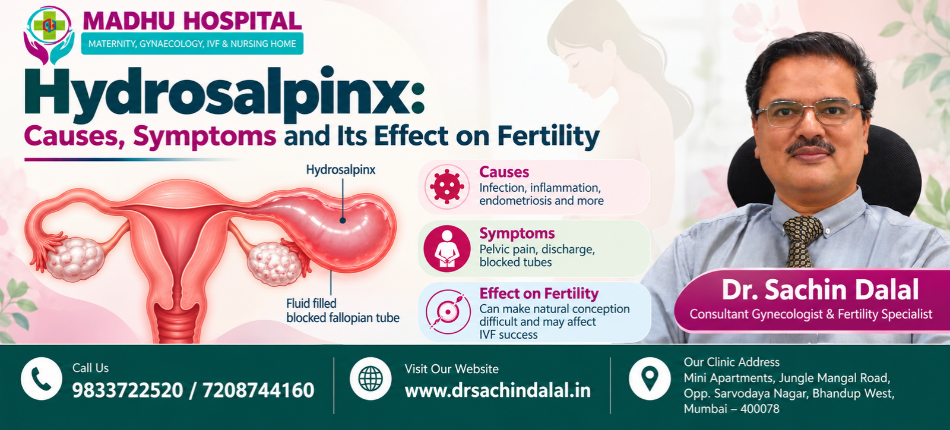
Hydrosalpinx: Causes, Symptoms and Its Effect on Fertility – Dr. Sachin Dalal
Hydrosalpinx is a reproductive health condition that can affect a woman’s ability to conceive naturally. It occurs when one or both fallopian tubes become blocked and filled with fluid, often due to previous infections, inflammation, or damage to the reproductive organs. Although some women experience pelvic discomfort or unusual vaginal discharge, many remain unaware of the condition until they undergo fertility investigations.
Understanding the causes, symptoms, and available treatment options is essential for women experiencing difficulty conceiving. Women looking for Hydrosalpinx Treatment in Mumbai can consult a qualified Gynecologist in Mumbai at Madhu Hospital for appropriate evaluation, diagnosis, and personalized treatment guidance.
At Madhu Hospital, timely diagnosis and appropriate gynecological care can help women better understand their reproductive health and explore suitable fertility treatment options.
In this article, we will discuss the causes, symptoms, diagnosis, treatment options, and effects of hydrosalpinx on fertility and pregnancy.
1. What Is Hydrosalpinx?
Hydrosalpinx is a medical condition in which a fallopian tube becomes blocked, swollen, and filled with fluid. The term comes from two words: “hydro,” meaning water or fluid, and “salpinx,” referring to the fallopian tube.
Fallopian tubes are essential components of the female reproductive system. They connect the region near the ovaries to the uterus and provide a pathway for the egg to travel. Fertilization normally occurs within a fallopian tube before the developing embryo moves toward the uterus.
When a fallopian tube becomes damaged or blocked, fluid may accumulate inside it, causing swelling and interfering with its normal function.
Hydrosalpinx may affect:
- One fallopian tube (unilateral hydrosalpinx): Only one tube is affected, while the other may remain healthy.
- Both fallopian tubes (bilateral hydrosalpinx): Both tubes are affected, potentially creating greater difficulties with natural conception.
The severity of hydrosalpinx varies from person to person. Some women may have mild tubal damage, while others develop extensive scarring and complete blockage.
2. What Causes Hydrosalpinx?
Hydrosalpinx generally develops when inflammation or damage causes the end of a fallopian tube to become blocked. Several underlying conditions may contribute to this problem.
A. Pelvic Inflammatory Disease (PID)
Pelvic inflammatory disease is one of the most common causes of hydrosalpinx. It is an infection-related inflammatory condition affecting the female reproductive organs, including the uterus and fallopian tubes.
When an infection spreads to the fallopian tubes, it may cause inflammation, swelling, and scar tissue formation. Over time, the affected tube can become blocked, allowing fluid to accumulate inside.
B. Previous Reproductive Tract Infections
Certain bacterial infections, including chlamydia and gonorrhea, may damage the fallopian tubes if they are not diagnosed and treated appropriately.
These infections can sometimes develop without noticeable symptoms, making early detection important.
C. Endometriosis
Endometriosis occurs when tissue similar to the uterine lining grows outside the uterus. This condition can cause inflammation, adhesions, and scarring around the reproductive organs.
When endometriosis affects the fallopian tubes or surrounding structures, it may contribute to tubal blockage and hydrosalpinx.
D. Previous Pelvic or Abdominal Surgery
Women who have undergone pelvic or abdominal surgery may develop adhesions, which are bands of scar tissue that form between organs.
These adhesions can affect the position and function of the fallopian tubes, occasionally contributing to blockage.
E. Previous Ectopic Pregnancy
An ectopic pregnancy occurs when a fertilized egg implants outside the uterus, most commonly inside a fallopian tube.
Damage related to an ectopic pregnancy or its treatment may increase the possibility of future tubal abnormalities.
F. Previous Pelvic Inflammation
Other inflammatory conditions involving the pelvic organs can also contribute to scarring and fallopian tube damage.
Identifying the underlying cause is an important part of planning appropriate Hydrosalpinx Treatment in Mumbai.
3. Common Symptoms of Hydrosalpinx
One of the challenges of hydrosalpinx is that it frequently develops without obvious symptoms. Many women discover the condition only when undergoing tests for infertility.
However, some women may experience the following symptoms.
A. Lower Abdominal or Pelvic Pain
Persistent or recurring discomfort in the lower abdomen may occur when the fallopian tube becomes swollen or inflamed. The pain may be mild or more noticeable during certain stages of the menstrual cycle.
B. Unusual Vaginal Discharge
Some women with hydrosalpinx may notice changes in vaginal discharge, including differences in consistency or colour. Unusual discharge can also indicate an infection and should be medically evaluated.
C. Difficulty Conceiving
Difficulty becoming pregnant is one of the most significant reasons hydrosalpinx is diagnosed. A blocked fallopian tube can interfere with the movement of the egg and sperm, reducing the possibility of natural fertilization.
D. Pelvic Discomfort During Menstruation
Some women experience pelvic pain that becomes more noticeable during or shortly after menstruation. However, menstrual pain can have several causes and does not necessarily indicate hydrosalpinx.
E. No Noticeable Symptoms
Many women have no pain, discharge, or menstrual changes. Hydrosalpinx may only be identified during an ultrasound, hysterosalpingography, or fertility investigation.
Important: Symptoms alone cannot confirm hydrosalpinx. A proper medical examination and diagnostic tests are necessary.
4. How Does Hydrosalpinx Affect Fertility?
Hydrosalpinx can interfere with natural conception and may also affect the outcomes of fertility treatments such as in vitro fertilization (IVF).
Understanding these effects is particularly important for women planning pregnancy.
A. Blockage Prevents Normal Fertilization
Normally, the fallopian tubes allow sperm and eggs to meet. When a tube becomes blocked, this process may be interrupted.
If both fallopian tubes are severely blocked, natural conception becomes extremely difficult.
B. Damage to the Fallopian Tube
Hydrosalpinx may damage the delicate structures inside the fallopian tube that help transport an egg or embryo.
Even if a tube is partially open, its ability to function normally may be reduced.
C. Fluid May Affect Embryo Implantation
Fluid accumulated inside a damaged fallopian tube may sometimes flow backward into the uterus.
This fluid can interfere with the uterine environment and may reduce the likelihood of successful embryo implantation.
D. Increased Risk of Ectopic Pregnancy
Women with damaged fallopian tubes have an increased risk of ectopic pregnancy.
If a fertilized egg cannot travel normally toward the uterus, it may implant inside the fallopian tube instead.
An ectopic pregnancy requires prompt medical attention because it can cause serious complications.
E. Reduced IVF Success Rates
Hydrosalpinx may negatively influence IVF outcomes, even though IVF bypasses the fallopian tubes during fertilization.
The presence of hydrosalpinx fluid can affect embryo implantation, which is why treatment of the affected tube is often considered before IVF.
Early diagnosis and appropriate management may help improve reproductive outcomes.
5. Can You Get Pregnant Naturally With Hydrosalpinx?
Natural pregnancy may still be possible in certain cases, particularly when hydrosalpinx affects only one fallopian tube and the other tube remains healthy and functional.
However, the chances of conception depend on several factors, including:
- Whether one or both fallopian tubes are affected.
- The extent of tubal damage.
- The woman’s age and ovarian reserve.
- The presence of endometriosis or other reproductive conditions.
- The reproductive health of both partners.
When both fallopian tubes are completely blocked, natural conception is generally not possible without treatment or assisted reproductive technology.
Women diagnosed with hydrosalpinx should discuss their pregnancy plans with a qualified gynecologist or fertility specialist before deciding on treatment.
6. How Is Hydrosalpinx Diagnosed?
A gynecologist may recommend several investigations to confirm hydrosalpinx and determine its severity.
A. Transvaginal Ultrasound
A transvaginal ultrasound uses sound waves to examine the uterus, ovaries, and surrounding reproductive structures.
A swollen, fluid-filled fallopian tube may appear as an elongated or tubular structure during the examination.
However, smaller or less obvious cases may require additional investigations.
B. Hysterosalpingography (HSG)
Hysterosalpingography is an imaging test used to evaluate whether the fallopian tubes are open or blocked.
During the procedure, contrast dye is introduced through the cervix into the uterus, and X-ray images are taken to observe the movement of the dye.
If the dye cannot pass through a fallopian tube normally, it may indicate blockage.
C. Diagnostic Laparoscopy
Laparoscopy is a minimally invasive surgical procedure that allows a doctor to examine the pelvic organs using a small camera inserted through an abdominal incision.
It may be recommended when further assessment of tubal damage, adhesions, or endometriosis is necessary.
D. Fertility Evaluation
Additional investigations may be advised when a woman is experiencing difficulty conceiving.
These may include ovarian reserve assessment, hormone testing, evaluation of ovulation, and semen analysis of the male partner.
A complete fertility evaluation helps doctors identify whether hydrosalpinx is the only factor affecting conception.
7. Hydrosalpinx Treatment in Mumbai: Available Treatment Options
The appropriate treatment for hydrosalpinx depends on the extent of fallopian tube damage, symptoms, age, fertility goals, and other medical conditions.
Treatment may involve medication for an associated infection, minimally invasive surgery, or assisted reproductive techniques.
A. Antibiotic Treatment
If an active bacterial infection is present, antibiotics may be prescribed to control the infection and prevent further complications.
However, antibiotics cannot usually reverse established scarring or reopen a severely damaged fallopian tube.
B. Laparoscopic Salpingectomy
Salpingectomy is a surgical procedure in which the affected fallopian tube is removed.
It may be recommended when the tube is severely damaged, repeatedly inflamed, or likely to interfere with IVF treatment.
Laparoscopic surgery generally involves small abdominal incisions and specialized surgical instruments.
Removing a severely damaged tube can prevent accumulated fluid from flowing into the uterus and may improve IVF outcomes in selected patients.
C. Salpingostomy
Salpingostomy is a procedure in which a surgeon creates an opening in the blocked end of the fallopian tube to allow fluid to drain.
This approach may be considered in selected women with mild tubal damage who wish to preserve the possibility of natural conception.
However, the tube may become blocked again, and the risk of ectopic pregnancy remains important.
D. Tubal Occlusion
Tubal occlusion involves blocking the affected fallopian tube near the uterus to prevent hydrosalpinx fluid from entering the uterine cavity.
This approach may be considered before IVF when appropriate.
E. In Vitro Fertilization (IVF)
IVF is an assisted reproductive technique in which eggs are collected from the ovaries and fertilized in a laboratory.
The resulting embryo is transferred directly into the uterus, bypassing the fallopian tubes.
For women with severe bilateral tubal damage, IVF may offer a possible route to pregnancy. However, an existing hydrosalpinx may need to be treated before embryo transfer.
The most appropriate treatment should always be determined through an individualized medical assessment.
8. Hydrosalpinx Surgery: When Is It Recommended?
Surgical treatment may be considered when hydrosalpinx causes persistent symptoms, significantly affects fertility, or may interfere with planned IVF treatment.
A doctor may discuss surgery in situations involving:
- Severe fallopian tube damage.
- Persistent pelvic pain associated with hydrosalpinx.
- Significant tubal blockage.
- Hydrosalpinx detected before IVF treatment.
- Recurrent fluid accumulation.
- Associated pelvic adhesions or other surgical conditions.
Not every woman diagnosed with hydrosalpinx requires immediate surgery.
The decision depends on symptoms, fertility goals, the condition of the opposite tube, and the potential benefits and risks of treatment.
9. Hydrosalpinx and IVF: Why Treatment Before IVF Matters
Hydrosalpinx is an important consideration for women planning IVF.
Although IVF bypasses the fallopian tubes during fertilization, fluid from a hydrosalpinx may enter the uterine cavity and interfere with embryo implantation.
Research has shown that untreated hydrosalpinx can reduce IVF pregnancy rates.
For women with clinically significant hydrosalpinx, doctors may recommend salpingectomy or tubal occlusion before IVF.
The purpose of these procedures is to prevent fluid from reaching the uterus and improve the conditions for embryo implantation.
The timing and type of treatment depend on the patient’s reproductive history, ovarian reserve, surgical risks, and fertility treatment plan.
10. Can Hydrosalpinx Affect Both Fallopian Tubes?
Yes. Hydrosalpinx can affect one or both fallopian tubes.
When only one tube is affected, the other tube may still function normally, allowing natural pregnancy in some women.
However, bilateral hydrosalpinx involves both fallopian tubes and can substantially reduce the chances of natural conception.
Women with bilateral hydrosalpinx may require a detailed fertility evaluation to determine whether surgery, IVF, or a combination of treatments is appropriate.
Early consultation can help patients understand their available reproductive options.
11. What Happens If Hydrosalpinx Is Left Untreated?
Untreated hydrosalpinx may continue to affect reproductive health, even when symptoms are mild or absent.
Potential consequences include:
Persistent tubal blockage: Existing damage may prevent normal egg and sperm transport.
Difficulty conceiving: Blockage and impaired tubal function can reduce natural fertility.
Ectopic pregnancy: Damaged fallopian tubes may increase the risk of pregnancy developing outside the uterus.
Reduced IVF outcomes: Fluid from the affected tube may interfere with embryo implantation.
Ongoing pelvic discomfort: Some women may experience persistent or recurring pelvic pain.
The condition does not always progress, but monitoring and appropriate medical guidance are important.
12. Recovery After Hydrosalpinx Treatment
Recovery after hydrosalpinx treatment depends on the type of procedure performed, the patient’s overall health, and the presence of other pelvic conditions.
After laparoscopic surgery, patients may experience temporary abdominal discomfort, bloating, or fatigue.
Doctors generally recommend adequate rest, appropriate wound care, and gradual resumption of normal activities.
Follow-up appointments help assess healing and determine when it may be appropriate to resume fertility treatment or attempt pregnancy.
Women planning conception should discuss the recommended waiting period with their treating doctor because recovery timelines vary.
13. Can Hydrosalpinx Be Prevented?
Not every case of hydrosalpinx can be prevented. However, certain preventive measures may reduce the risk of infections and inflammatory conditions that can damage the fallopian tubes.
A. Seek Early Treatment for Pelvic Infections
Prompt medical evaluation and appropriate treatment of pelvic infections may help reduce the risk of long-term tubal damage.
B. Practice Safer Sexual Health
Using appropriate protection and undergoing recommended testing for sexually transmitted infections can help reduce infection-related reproductive complications.
C. Do Not Ignore Persistent Pelvic Pain
Recurring lower abdominal pain, unusual discharge, or symptoms of infection should be evaluated by a qualified healthcare professional.
D. Attend Regular Gynecological Checkups
Routine gynecological consultations can help identify reproductive health concerns and provide an opportunity to discuss fertility planning.
E. Seek Timely Fertility Evaluation
Women experiencing difficulty conceiving should consider medical evaluation rather than delaying investigations, particularly if they have a history of pelvic infections, endometriosis, or previous tubal surgery.
14. When Should You Consult a Gynecologist?
Women should consider consulting a gynecologist if they experience persistent pelvic pain, unusual vaginal discharge, or difficulty becoming pregnant.
A fertility evaluation is generally recommended after 12 months of regular unprotected intercourse for women younger than 35, or after 6 months for women aged 35 or older. Earlier evaluation may be appropriate when there is a known history of tubal disease or other fertility concerns.
Seek urgent medical care if you experience severe abdominal pain, fainting, shoulder-tip pain, or vaginal bleeding with a positive pregnancy test, as these can be warning signs of an ectopic pregnancy.
Timely diagnosis can help identify reproductive conditions and support appropriate treatment planning.
15. Hydrosalpinx Treatment in Mumbai at Madhu Hospital
Women experiencing symptoms of hydrosalpinx or difficulty conceiving may benefit from a comprehensive gynecological and fertility evaluation.
When seeking Hydrosalpinx Treatment in Mumbai, it is important to understand the underlying cause, severity of fallopian tube damage, and possible implications for future pregnancy.
Madhu Hospital encourages awareness of women’s reproductive health and the importance of appropriate medical consultation.
Depending on clinical findings, a treating specialist may discuss diagnostic investigations, infection management, surgical treatment, or referral for assisted reproductive care.
Every woman’s reproductive health needs are different, and treatment decisions should be based on individual medical circumstances.
Conclusion
Hydrosalpinx is an important reproductive health condition that can affect natural conception, increase the risk of ectopic pregnancy, and influence IVF outcomes. Because many women experience few or no symptoms, the condition may remain undetected until fertility investigations are performed.
Understanding the causes, recognizing possible symptoms, and seeking timely medical evaluation can help women make informed decisions about their reproductive health.
Treatment options may include management of infections, laparoscopic surgery, tubal occlusion, or assisted reproductive techniques, depending on the extent of tubal damage and individual fertility goals.
For women seeking Hydrosalpinx Treatment in Mumbai, consulting a qualified gynecologist or fertility specialist is an important step toward understanding the condition and exploring suitable treatment options.
Consult Madhu Hospital for guidance on gynecological concerns, fertility evaluation, and appropriate next steps based on your medical needs.
Hydrosalpinx Treatment in Mumbai Hydrosalpinx Treatment in Mumbai Hydrosalpinx Treatment in Mumbai Hydrosalpinx Treatment in Mumbai Hydrosalpinx Treatment in Mumbai Hydrosalpinx Treatment in Mumbai Hydrosalpinx Treatment in Mumbai Hydrosalpinx Treatment in Mumbai Hydrosalpinx Treatment in Mumbai Hydrosalpinx Treatment in Mumbai Hydrosalpinx Treatment in Mumbai Hydrosalpinx Treatment in Mumbai Hydrosalpinx Treatment in Mumbai Hydrosalpinx Treatment in Mumbai Hydrosalpinx Treatment in Mumbai Hydrosalpinx Treatment in Mumbai Hydrosalpinx Treatment in Mumbai Hydrosalpinx Treatment in Mumbai Hydrosalpinx Treatment in Mumbai Hydrosalpinx Treatment in Mumbai Hydrosalpinx Treatment in Mumbai Hydrosalpinx Treatment in Mumbai Hydrosalpinx Treatment in Mumbai Hydrosalpinx Treatment in Mumbai