
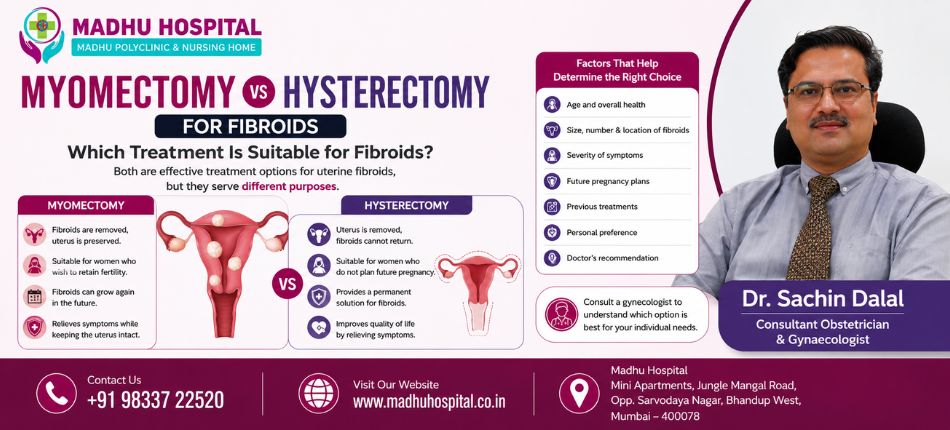
Myomectomy vs Hysterectomy for Fibroids : Which Treatment Is Suitable for Fibroids? – Madhu Hospital | Dr. Sachin Dalal
Introduction
Uterine fibroids are non-cancerous growths that develop in or around the uterus. While some women with fibroids experience few or no symptoms, others may develop heavy menstrual bleeding, pelvic pain or pressure, frequent urination, abdominal enlargement, or reproductive concerns.
When symptoms significantly affect everyday life and conservative treatment is insufficient or unsuitable, surgery may be considered. Two important surgical options are myomectomy and hysterectomy.
Understanding Myomectomy vs Hysterectomy for Fibroids is particularly important because the two procedures have fundamentally different goals. A myomectomy removes the fibroids while preserving the uterus, whereas a hysterectomy removes the uterus and provides definitive treatment for uterine fibroids.
The appropriate treatment depends on several individual factors, including symptoms, age, fibroid size and location, overall health, and future reproductive plans.
What Are Uterine Fibroids?
Uterine fibroids, also known as leiomyomas, are benign growths arising from the muscular tissue of the uterus. They can vary significantly in number, size, and location.
Fibroids may be located within the uterine wall, project into the uterine cavity, or develop toward the outside of the uterus.
Not every fibroid requires treatment. Some women have fibroids without knowing about them because they do not cause noticeable symptoms.
Treatment is generally considered based on symptoms and their impact rather than simply the presence of a fibroid.
Common Symptoms of Fibroids
Depending on their size and location, fibroids may be associated with:
- Heavy or prolonged menstrual bleeding
- Pelvic pain or pressure
- Abdominal fullness or enlargement
- Frequent urination
- Constipation in some cases
- Pain during intercourse
- Anaemia resulting from heavy bleeding
- Fertility or pregnancy-related concerns in selected patients
Because similar symptoms can occur with other gynecological conditions, proper evaluation is important before deciding on treatment.
How Are Fibroids Diagnosed?
Evaluation usually begins with a detailed medical history and gynecological examination.
Ultrasound is commonly used to identify fibroids and evaluate their size, number, and location. Depending on the clinical situation, additional investigations may sometimes be recommended.
Treatment decisions should be made only after the doctor understands the patient’s symptoms, reproductive goals, and relevant investigation results.
What Is a Myomectomy?
A myomectomy is an operation that removes uterine fibroids while leaving the uterus in place.
The procedure may be particularly relevant for women who wish to preserve their uterus, including those who may want to consider future pregnancy.
The surgical approach used for myomectomy depends on factors such as the size, number, and location of fibroids.
Depending on the individual case, myomectomy may be performed through hysteroscopic, laparoscopic, robotic where available and appropriate, or open surgical approaches.
Potential Benefits of Myomectomy
The defining benefit of myomectomy is that it preserves the uterus while removing selected fibroids. This can make it an important option for women who wish to retain their uterus or for appropriately selected patients with future fertility goals. By removing symptomatic fibroids, myomectomy may help improve problems such as heavy menstrual bleeding, pelvic pressure, or discomfort. However, because the uterus remains in place, new fibroids can potentially develop in the future, and existing small fibroids may grow over time.
What Is a Hysterectomy?
A hysterectomy is an operation to remove the uterus.
Because fibroids originate in the uterus, hysterectomy provides definitive treatment for uterine fibroids—the fibroids cannot recur in the uterus once it has been removed.
However, pregnancy is no longer possible after hysterectomy. This makes future reproductive plans one of the most important considerations when discussing the procedure.
The exact type and surgical approach depend on the patient’s condition, anatomy, previous surgeries, fibroid characteristics, and other clinical factors.
Potential Benefits of Hysterectomy
For women with significant fibroid-related symptoms who do not wish to preserve fertility, hysterectomy may offer a definitive surgical solution because removal of the uterus eliminates the possibility of uterine fibroids recurring. It can be considered in selected patients with large, multiple, or recurrent symptomatic fibroids when clinically appropriate. However, hysterectomy is major surgery, and the potential benefits, risks, recovery, and long-term implications should be carefully discussed with a gynecologist before making a decision.
Myomectomy vs Hysterectomy for Fibroids: Key Differences
| Factor | Myomectomy | Hysterectomy |
|---|---|---|
| What is removed? | Fibroids | Uterus |
| Is the uterus preserved? | Yes | No |
| Future pregnancy | May remain possible depending on individual circumstances | Not possible |
| Can uterine fibroids develop again? | Yes, potentially | No |
| Main objective | Remove fibroids while preserving uterus | Definitive surgical treatment |
| Surgical approach | Depends on fibroid size/location/number | Depends on individual clinical factors |
| Best suited for | Selected patients wishing to preserve uterus | Selected patients who do not need uterine preservation |
This comparison provides general information only. Individual recommendations require clinical assessment.
Fertility: An Important Difference
For women who want to become pregnant in the future, preserving the uterus is essential.
This is one reason myomectomy may be considered in appropriate patients. However, removing fibroids does not automatically guarantee pregnancy, because fertility can be affected by many different factors.
The relationship between fibroids and fertility also depends on fibroid size, number, and location.
A gynecologist can assess whether fibroids may be affecting fertility and discuss appropriate management.
Hysterectomy, by contrast, removes the uterus, so carrying a pregnancy is no longer possible afterward.
Can Fibroids Return After Myomectomy?
Yes. Myomectomy removes existing fibroids that are targeted during surgery but does not prevent new fibroids from developing.
The likelihood of recurrence varies between individuals.
This possibility should be considered when discussing long-term treatment plans, particularly in younger patients.
Can Fibroids Return After Hysterectomy?
Uterine fibroids cannot recur after the uterus has been removed.
This is why hysterectomy is considered a definitive surgical treatment for uterine fibroids.
However, the decision to undergo hysterectomy involves considerations extending beyond fibroid recurrence, including reproductive plans, surgical risks, recovery, and personal preferences.
Which Procedure Has a Faster Recovery?
Recovery cannot be compared simply by the names of the procedures.
It depends considerably on whether surgery is performed hysteroscopically, laparoscopically, vaginally, or through an abdominal incision, as well as the complexity of surgery and the patient’s overall health.
Minimally invasive approaches may offer shorter recovery for appropriately selected patients compared with open abdominal surgery, but not every patient is suitable for every surgical technique.
Myomectomy vs Hysterectomy: Which Is Better?
There is no single answer that applies to every woman.
The choice between Myomectomy vs Hysterectomy for Fibroids may depend on:
- Age
- Severity of symptoms
- Size of fibroids
- Number of fibroids
- Location of fibroids
- Previous treatments
- Previous surgeries
- Desire for future pregnancy
- Desire to preserve the uterus
- Overall health
- Individual preferences
A detailed consultation with a gynecologist is therefore essential.
Conclusion
Both myomectomy and hysterectomy can play important roles in treating symptomatic uterine fibroids, but their objectives are different.
Myomectomy removes fibroids while preserving the uterus, whereas hysterectomy removes the uterus and provides definitive treatment for uterine fibroids.
The right option should not be selected based on age or fibroid size alone. A personalized assessment that considers symptoms, fibroid characteristics, overall health, reproductive goals, and patient preferences is necessary.
For evaluation and guidance regarding fibroids and gynecological treatment options, consult the gynecology team at Madhu Hospital.
Myomectomy vs Hysterectomy for Fibroids Myomectomy vs Hysterectomy for Fibroids Myomectomy vs Hysterectomy for Fibroids Myomectomy vs Hysterectomy for Fibroids Myomectomy vs Hysterectomy for Fibroids Myomectomy vs Hysterectomy for Fibroids Myomectomy vs Hysterectomy for Fibroids Myomectomy vs Hysterectomy for Fibroids Myomectomy vs Hysterectomy for Fibroids